Writing what I don’t know: Language and dialects in Revolving Door

Increasingly, I’ve been pondering the ways that my background as a speaker of “outer circle English” has shaped the way I write my characters. They say write what you know, because the authenticity of your voice will show. But at times, I feel like writing Revolving Door has been an exercise in the opposite: in writing what I don’t know.

As a preface, I probably need to outline my linguistic background. I’m Singaporean; Singapore is an ex-British colony, and English is the language of business and of instruction. But the kind of English we speak in vernacular contexts—Singlish—is really an English creole, mixing grammatical structures and vocabulary from several languages—most notably Hokkien, Malay, Mandarin, Cantonese, and Tamil. Indeed, growing up, English was only one of at least five widely spoken languages in my vicinity, and even within my family, 3 different languages were used daily.

But English and Singlish were the ones I had the most exposure to by far, particularly as a student. Because our classes were taught in English, most of my literary diet was also in the English language. The books we studied in school and the ones we talked about in our friend groups were usually by authors from the United Kingdom, the United States, and occasionally Australia.

I started with Enid Blyton (British), then graduated to Deltora Quest (Australian). After a diverse and messy stint with a dozen different favourites randomly picked out off library shelves, the Flora Trilogy (American) became my favourite book series. Then the Lord of the Rings (British) did. I read Wuthering Heights and Richard the Third (both British) for my ‘A’ levels, and today, I add the Leviathan Trilogy (American), Moby-Dick (American), Pride and Prejudice (British), and To Say Nothing of the Dog (British) to my roster of favourite novels.

It is not a particularly diverse repertoire. And yet it was typical of someone of my profile—a Singaporean literature student. In my mind, there was no dissonance. To me, stories were about escapism to a world that doesn’t exist, and said fiction was an atlas of cultures I had no other contact with.

Yes, the alternate universe steampunk San Francisco of Flora Segunda and the Literally England of Wuthering Heights were about as real to me as Middle Earth, and all occupied the same region of my mind for a very long time. In my mind at the time, these were the places where stories were meant to happen.


I began writing my first novel when I was 9, inside a school exercise book. In that novel, the main character, a violinist, discovers that her new violin is magical, before it transports her into a fantasy world where she learns how to play it to overcome a series of trials.

I never got past page 20, but how I wish I could find it again. I would like to imagine being that version of me again, putting down the first words of their first novel, taking their first steps on what—unbeknownst to me at the time—would be a grand journey of over a million words.

You could tell, even then, how all my influences were leaking into my writing: video games, music lessons, and the secondary worlds that are so common in British children’s fantasy. There was no sense of locality in these stories; they simply happened in a Generic Fantasy Land which just so happened to resemble the English countryside.

Those settings weren’t the only literary import that sat at odds with my lived reality. I used to admire authors who had an intrinsic understanding of UK and US dialects of English, because these books would often effortlessly render character voices and accents like those heard in film. “Character voice” and “character accent” were synonymous in my head.

And so, it was beyond disappointing to find that my own attempts to replicate them came out looking like an apostrophe soup. I didn’t understand patterns of elision, why certain speech patterns omitted certain words or vowels. I applied every single elision I had ever seen at the same time, like so:

What’re ya sayin’? Ya s’pose he’s pullin’ m’ leg?

I would construct these monstrosities to make a character sound casual—usually some jaunty rapscallion type—because it’s what I had seen different authors in different books do. Except, of course, each author was effecting a different accent, and I lacked that context, because I had never heard those accents in real life.


I’ve since come to embrace that character voice is about so many things other than accent—how patterns of speech reveal patterns of thought, fears, desired outward image. And I still don’t know how to write those English accents. But I now understand that those authors are able to write them because they frequently hear them.

I could, however, write a mean Singlish accent. I could write a Singaporean teacher, a Singaporean hawker centre auntie, a Singaporean politician. But alas, there were entire campaigns to eradicate Singlish in common parlance, and these language policies ultimately inculcated in me a sense of shame about my own dialects in professional settings. So I never wrote a Singaporean character speaking Singlish for fear of being seen as unsophisticated (in a way that writing an “unsophisticated” regional UK dialect wasn’t, for some reason).

In my formative years as a young writer, British and American literature came to form my internal conceptual model of what writing is before I was cognizant enough of geopolitics to interrogate how this situation came to be. I wrote largely Europe- and US-adjacent settings, and if I did write about Asian cultures (or ones coded that way), it was typically in a self-orientalising way—as if favouring the tourist guide version over my lived reality. (I couldn’t reconcile my lived reality with the versions of East and Southeast Asia portrayed through the Western gaze.)

And you can feel all of this, at times, in Revolving Door. Why are there so many American and British characters and settings in my stories? Because, for a time in my life, I believed stories were meant to be set there.


I created most of Revolving Door‘s principal cast when I was 18 and still in school. By then, I was starting to understand the catharsis of diversity and representation (ironically, for someone living in a place both very culturally diverse and lacking a widespread discourse on such issues). That is what saved the RD cast from being blander than it is. 18-year-old me, who had never set foot in the Western hemisphere before, decided that they would begin the story in the US. I was an avid fan of the Flora Trilogy by Ysabeau Wilce and the Leviathan Trilogy by Scott Westerfeld at the time; the fact that I have a character from San Francisco and a rural dweller who enlists in the British army signifies the indelible imprint my interests at the time have left on RD.1

1 Both of these series are also quite diverse and address issues of representation, I should note! The Flora Trilogy is set in an AU California (“Califa”) where the Aztec Empire overcame European colonisers and now controls the state through a puppet leader. The Leviathan Trilogy visits countries across the world during World War 1, exploring their political complexities in some depth, and it has both bisexual and gender non-conforming main characters.

I’m the sort of person who holds fast to basic details of my characters’ profiles, even when my understanding of the world, history, and current issues has grown. I’m reluctant to ever change my characters’ names, backgrounds, and even designs, except slowly and incrementally.

But that begets a problem. A lot of the character profile choices I made as a teen because “it’s cool and I want to combine everything I find cool from stories I like” don’t hold up under the lens of realism. For example, I realised in 2018 that the last name “Arbora” (which I came up with in 2014, apropos of nothing besides associating Fen with trees) does not sound even remotely Fiijan or Malaysian, his parents’ cultures. But because I’d already written his name into the novel, I came up with roundabout genealogical explanations and gave him middle names and relatives with parts of his name, rather than even thinking of altering that basic biographical fact.

Revolving Door has been a 13-year project in “yes-and”-ing the creative decisions I made at 18. Why does my character look this way and live in this location? Here’s a family history that explains it. Why does my character have a middle name that makes no sense being from their culture? Well, because they have a relative with that name for whose culture it would make sense.

So, although I look back and wish that I had geographically spread out my principal cast just a little more, I never changed anyone’s place of origin. And as a result, the fact that my principal cast has two Brits, one American, and a few characters from a world based on a work of British literature will always stand as testament to the baggage of my writerly origins.


Although I never lived long-term in the US, I consumed enough American media growing up that I can fake a generic American feel in my dialogue. If Adelaide sounds natural, then I’ve succeeded. Hong Yi too, though realistically, having only lived in the US for maybe two years, he wouldn’t sound quite as American as how I wrote him.

I say “generic” because I don’t have enough local familiarity to pin down the dialect of a specific locale. I’ve never been good with writing regional American and British dialects I’ve never heard, and I don’t think I can ever be. The most I can do is look up common phrases / expressions from that locale and apply them as markers of places of origin.

The fact I could not simply “figure out” accents and dialects was devastating to me, as someone who has always striven assiduously to make my depictions of real-world locations feel true to life. But while I can take virtual walks on Google Maps and read location-specific forums to get a feel of being on the streets, I cannot learn how to speak like a local just by watching videos. Perhaps this is simply something I do not have a sense for.

For a long, long while, I thought this made me a bad writer—a lack of instinct in turning spoken words into sounds, coupled with the insurmountable hurdle of being Singaporean.

Yes, I’m sure that I could have researched my way to compelling realism, but that’s the thing, isn’t it—I was trying to write in regional accents that authors from England and the US would not have had to go to such lengths for, all just to imitate them. When they write about cultures beyond their own, the don’t tend to be very accurate, either. The difference? Perhaps because of global power asymmetries, they don’t tend to have to care if it’s poorly done. No one (until recently) has had the platform to criticise it, in the same way that western, Anglophone professionals regularly criticised poorly-written regional accents close to home.

These days, I have decided I no longer care that much about regional English dialects as some hallmark of good writing, particularly after coming to recognise that accents are often seen as a way to exotify a character to a global northern, Anglophone audience.

RD has a lot of characters speaking a lot of regional dialects! I don’t think I am able to adequately research every single one, and I refuse to only put in that effort for a select few while allowing others to be inaccurate.


I think of creative writing as the act of translating experiences into words, and here, perhaps, the translation is literal. This is, after all, a story where two main characters have the ability to hear everything everyone says in their own language—the nature of the story’s text as an approximation of the true experience is somewhat encoded in the worldbuilding.

And this story is probably a better translation of the scenarios I envision if I’m not trying to clumsily effect dialects I’ve never heard, from regions I’ve never lived in, from cultures that aren’t mine. Some of my characters probably do speak differently from how I write them, and I am perfectly happy for readers to imagine them expressing themselves in a different way, if they know those voices better. I have merely translated them through the lens of my own linguistic history.
Published
Categorized as Writing Tagged

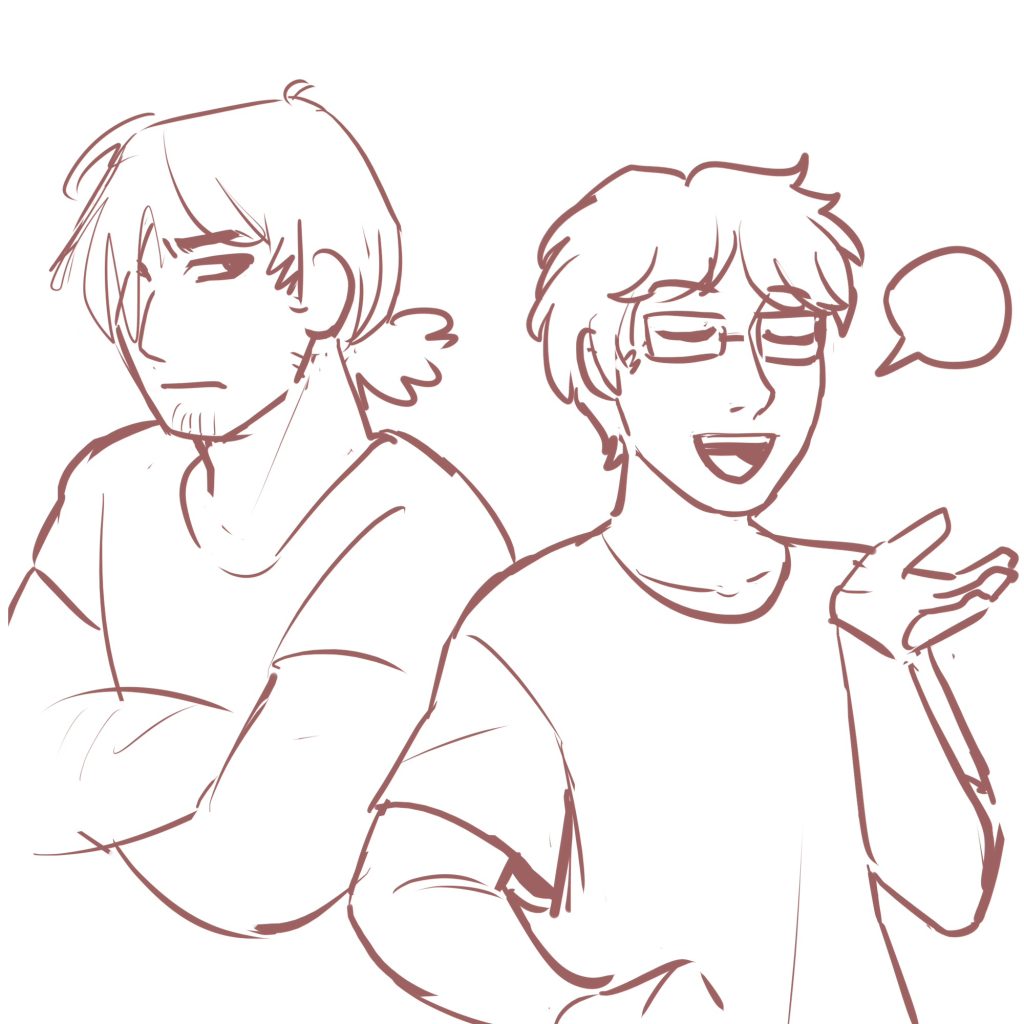
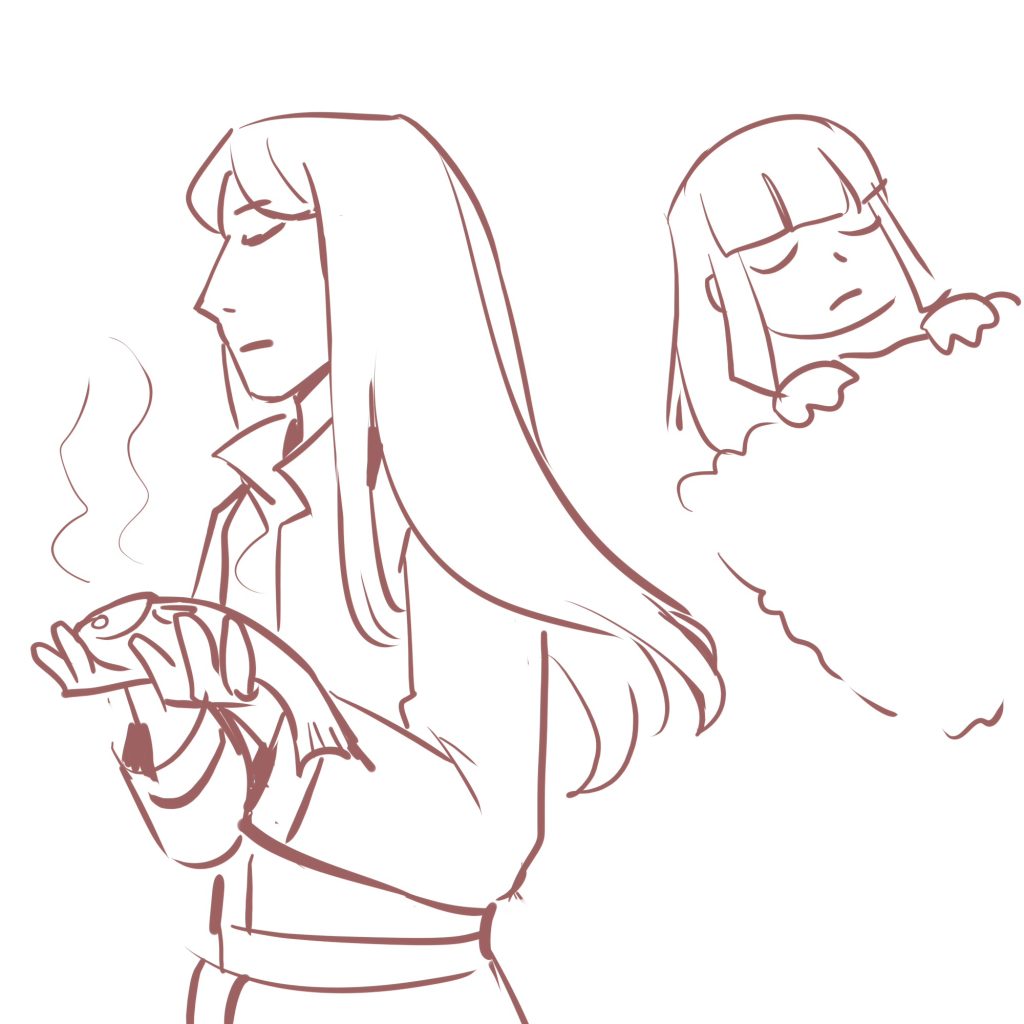
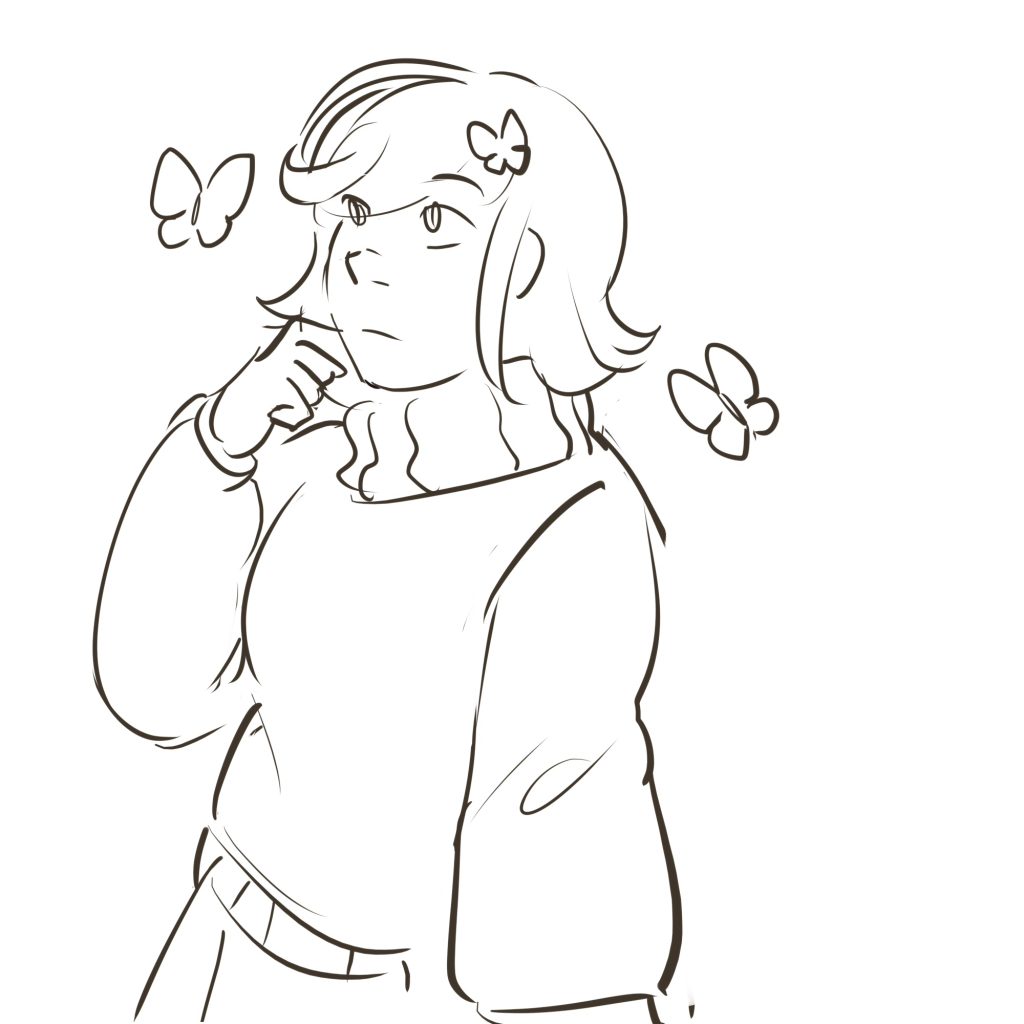
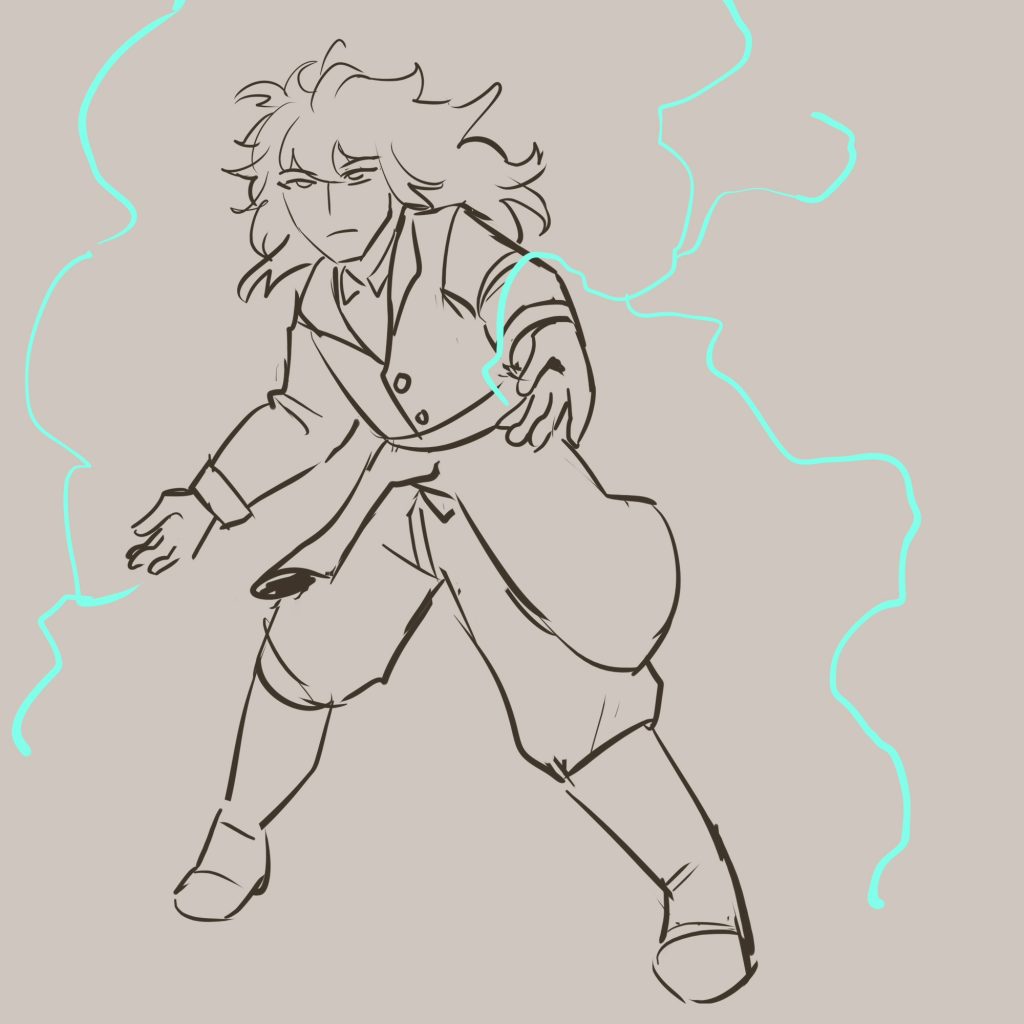
Some Team Orobelle doodles + commentary

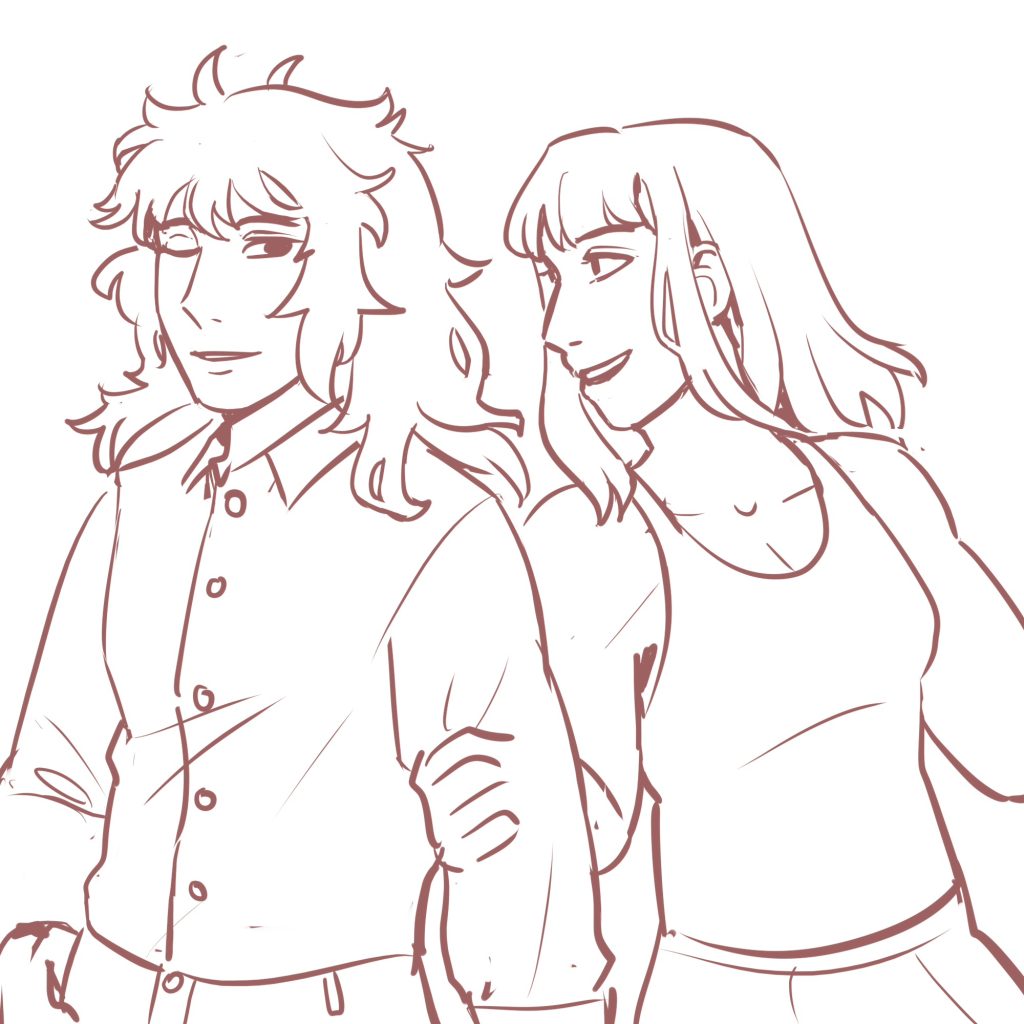
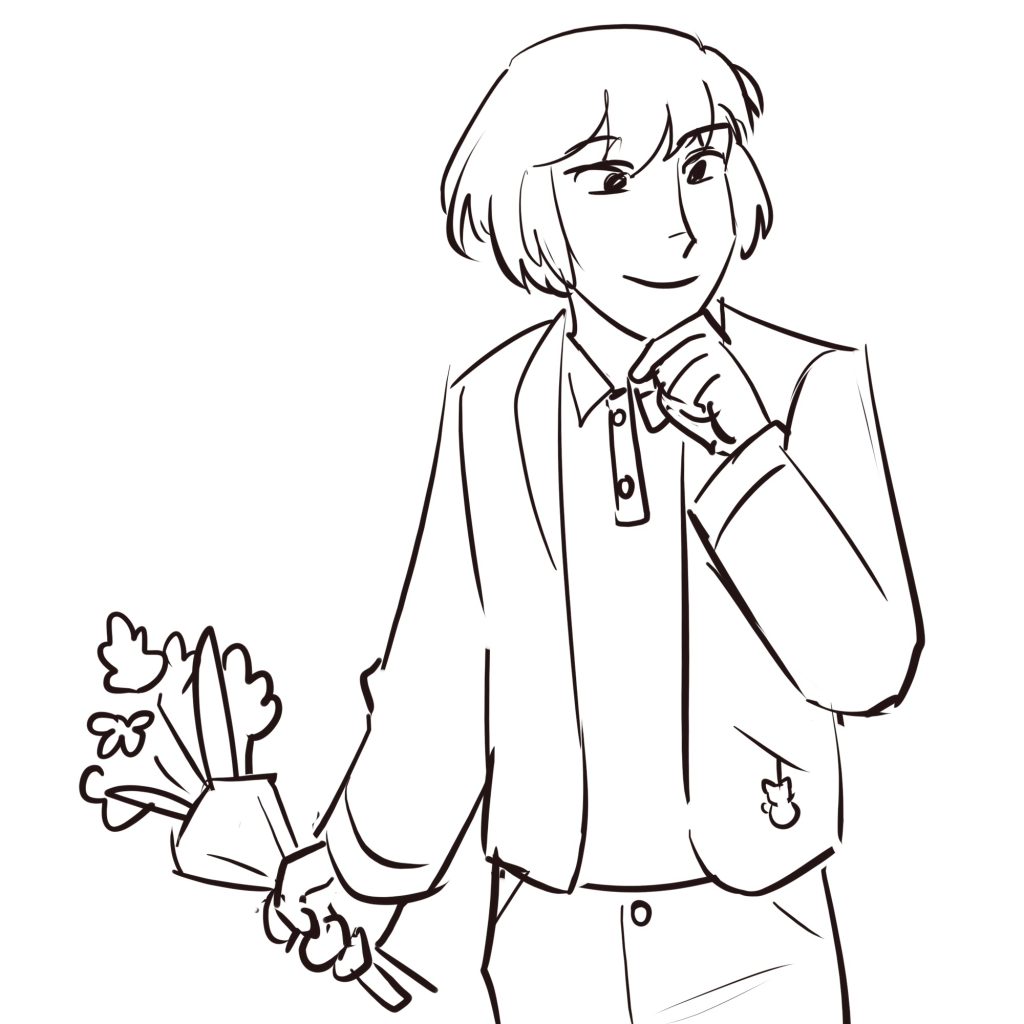
I was just musing on the characters yesterday evening and scribbling them. A bit of commentary on these:

  1. I am a huge fan of the sort of relationship dynamic where one character is very attuned to emotional cues and the other Knows Nothing. In romantic relationships it makes for some extremely fun writing. Anyway Vesper hasn’t figured out that Marcia is head over heels, water is wet, more at 9.
  2. Felix probably dresses like this in Adelaide’s world. Despite the way he was raised, he’s open to trying different things presentation-wise. Spoilers for chapter 48: I imagine Adelaide left behind her night market purchases in the hotel room when the CIA dragged her back home and Felix kept the cat keychain (which is hanging from his pocket in the pic). If you think about it, he is the solar powered lucky cat.
  3. Artur and Hong Yi have (to me) a deeply entertaining dynamic. There is a very strong surface-level personality clash that continues to have an effect even as they get to know each other better and recognise some points of connection. Orobelle always puts them in the same room when she’s the one determining lodgings; she’s like, “let’s group them by gender…I think that’s how things are done.”
  4. Dorian cooking a fish (Chapter 45) while Orobelle naps next door. I still laugh about that mini scene sometimes. He’s never cooked a fish in his life (his homeland doesn’t have much in the way of bodies of water) so he definitely overestimates how much heat they take to cook through. I think Orobelle sleeping while he does favours for everyone else is pretty indicative of their dynamic.
  5. Adelaide with butterflies…the idea of butterflies emerging from cocoons was always, in my mind, an apt parallel for her departure from the lab room after years inside it, imagining how the world beyond has changed while also being changed irreversibly by it. I imagine she’s the sort of person who could sit there watching living things interact for hours (…relatable…)
  6. Vesper using her powers. In her original character concept, like from when RD was conceptualised as a fighting game with world-switching mechanics, she was the “circuit completer,” and even now I almost always portray the electricity moving from one hand to the other or from her hand to the ground, because that’s how I picture her powers working. It’s really just based on lightning—cloud-to-cloud or cloud-to-ground.

A tale of three multiverses

Just an indulgent reflection on my creative writing, Homestuck, Revolving Door, and the catharsis of multiverse fiction.

So picture 2014, mid-Megapause. That was the year Flight MH370 vanished, the year the ebola epidemic began. I was a year into my bachelor’s degree, and my father was battling Stage 4 cancer. That was the year I read Homestuck.

Up till then, my favourite works of fiction had been ones where personal narratives were rendered small and yet immensely important against a backdrop of geopolitics, tales where the protagonists were doomed from the start, or where the only victory possible was a Pyrrhic one. Think Lord of the Rings, Les Misérables (the musical), Oban Star Racers.

Importantly, these were all stories quite entrenched in the conventions of their genres—full of gravitas and sorrow, and perfectly sincere in their treatment of tragedy.

At some point, though, I realised I craved something different.

It was, of all things, Marvel’s Avengers that gave me my first toddling glimpse of what that might be. It presented to teen-me, and to the 2012 milieu, a highly visible and much-discussed work of fiction that united five fully-realised stories.

It wasn’t just that it united five stories, though. It was that it united five worlds, each with their own internal narrative logics—endemic worldviews, moral quandaries, character arcs, themes, and motifs. It reconciled them in a single work, in a way that felt like it developed each tributary work’s themes and characters consistently, both within each separate world and within this merged one.

I don’t view The Avengers with such a rose-tinted view now (seeing as the MCU went on to bring the concept of “franchise fatigue” into existence). But nevertheless, this was the work that seeded my interest in multiverse fiction, by using it not as a plot device, but as a rhetorical one. A trick of form, like a metaphor in a poem, or a repeating refrain in prose, to underscore its thematic weight.

Marvel had, in effect, simulated a crossover—on a scale and with a coherence I’d never seen prior to then.


I’m not sure how many people following me in the present know about my history of novel writing. Novels have always been my preferred way of realising narratives. It started with 100- to 200-page stories that I would write in between classes, while waiting to be picked up from school, at 2am under the light of my phone, and then on said phone.

From the ages of 14 to 18, these interests culminated in Of the Dragon, of the Stars, a stock-standard epic fantasy novel that began as MapleStory fanfic, took me 6 years to complete, and became my first taste of internet visibility. OTDOTS took me so long to write that I wrote another novel, Eagles and Swans, from start to finish, in the middle of its protracted run (it’s also a slightly better novel in my opinion; I’ve rewritten it 4 times).

Anyway, at the time when I watched The Avengers, I was tantalisingly close to completing OTDOTS, and already had in my mind the idea of starting something new and different. When I experienced Marvel’s simulated crossover, it suddenly clicked that I knew what I wanted that to be.

Revolving Door is what came of that. It was “the most complex story I could come up with” in 2012: a multiverse of 12 worlds (12 because it had been a long-time arc number for me), each one embodying a different fiction genre, each to be fleshed out as an independent story before its plot thread was pulled into the loom of the converging mega-plot.

It was taking the template of The Avengers and making it my own—simulating a crossover among the range of fiction genres I enjoyed, and trying to mesh their different narrative logics with each other. It had:

  • A Wars of the Roses-inspired clockwork fantasy world featuring an expansionist empire with infighting noble houses,
  • An islandic low fantasy setting drawing from Southeast Asian traditions with magic cast with folded cloth,
  • A cyberpunk dystopia where four megacorporations have subsumed the US,
  • A world embroiled in World War 2 well after it was meant to end,
  • A Victorian solarpunk world centred on social and romantic drama against the backdrop of a solar technological revolution,
  • A magic realism tale set on a fictitious Pacific island,
  • A slice-of-life tale set in Boston,
  • An alternate history where the Roman Empire never collapsed, and
  • A nuclear apocalypse hellscape.

And importantly, it had one singularly important character—a child named Orobelle—who held all the universes together simply by being alive. Who, if killed, would bring every reality tumbling down.

RD would be designed to be readable in a flexible/nonlinear order (you could pick which universe to start with), but all of those plotlines would eventually converge into one. To that end, I made a story map…in 2024, after planning to for years.

Anyway, in the two years before I started writing RD, and for two more years thereafter, I’d been growing peripherally aware of a work of fiction called Homestuck. Two of my friends followed it, and when I described my incipient RD outline to one of them, the first thing they said was: Orobelle reminded them of a character in Homestuck whose heart contained the universe.

That didn’t immediately mark it in my mind as a work of fiction I wanted to read, but it did tell me a lot about Homestuck’s tone, scale and thematic threads: that it’s a story that engages with the scale of the universe, and employs the body as a metonym for reality. Just as I was doing in RD.

Well, I later noticed a pattern with Homestuck fanart: that each character seemed to be associated with firmly reiterated iconography like ghosts, atoms, and vinyl records…just like I did with my own writing.

And at that point, I caved and started reading it.


I don’t actually think Homestuck is unique in many of the ways that people believe it is. Messing with the interface to convey plot or themes is a beloved video game trope. Arc numbers have been done since time immemorial. Even fiction that speaks to and about its medium was done in the Thousand and One Nights. And nested universes? The Avatamsaka Sutra did it first.

But what Homestuck does with those influences, which any work with a metafictional bent tends to need to do, is draw from the fiction traditions that came before and re-present them for the cultural niche to which it speaks. None of these traits in isolation is unique, but Homestuck takes them and makes something new of them.

I read all that existed of Homestuck up to the Megapause in 9 days. I remember because I was keeping track. I would wake in the morning, start reading it, and not stop for anything except meals and bedtime. It gripped me and it never let go.

Then, in the ensuing months, I found that it had changed the way I wrote, for good. My writing always leaned heavily towards, let’s call it, the Tolkienian camp—meticulously attending to the internal consistency of its worldbuilding, asserting the total self-complete reality of its fictional universe, and rarely ever making fun of itself.

Homestuck is the weird great grandchild of Tolkien, via Dungeons and Dragons, then RPG video games. And along the way, it came to embody what feels like the opposite of Tolkienian gravitas. It pokes fun at the conventions that most stories are beholden to, and those that the audience holds in their minds as they read. It calls attention to its fictionality while at the same time keeping suspension of disbelief intact through immersive worldbuilding and character drama that relies on its metafictional commentary.

As in, Homestuck is about four kids trying to escape the game they’re in—a game that is responsible for their existence in the first place. Their reality—the reason they exist—is the webcomic, and their actions end up altering the interface and structure of the webpage itself.

And definitively—maybe most definitively—it uses the language of the internet.

We’ve had fiction that comments on itself for ages. And even among internet media, Animator vs Animation was a childhood staple of mine, so the idea of characters breaking the fourth wall by messing with the interface was never an alien concept. What is truly unprecedented about Homestuck is that:

  1. it is a commentary about fiction made for the internet,
  2. it is a cosmogony, a story about how a universe came to be, which lends it a religious heft that few other self-referential works attain, and
  3. it has something to say with those interface gimmicks—a thesis about the determinism of the narrative/reality.

And importantly, it does so without…being self-important? It never posited to be a Great Work, a profound commentary, or a revolution in webcomic storytelling. It was a messy, crowsourced text adventure that borrowed the visual language of video games. And it told its story through a glorious bricolage of forgettable old movie references, bewildering nods to current affairs, extra deep-fried JPEGs, and some of the most beautiful art I’ve ever seen in a comic.


In 2012, my grandfather, whom I had seen every day of the previous five years, passed away. In 2013, my father received what we all believed to be a terminal diagnosis. In two short years, I got to experience my world ending, and the struggle of learning how to carry on anyway.

I started writing Revolving Door in 2013, in between those two events. I continued writing it in tandem with my father’s evolving health condition. So it is a story that came fully from grief, from the universe-rending horror of being forced to confront not just death, but also the end of the world as I knew it.

That’s the part I’ve never seen anyone say about grief. It made me feel like I wasn’t living in the same world anymore, as if a new one had taken its place overnight. I had to come to terms with watching a person who had once held absolute authority over me become fully reliant on nurses and drips, unable even to go to the bathroom by himself. I had to come to terms with the idea that someone I loved could be conscious and lucid one day, and the next, gone.

More than ever, I had to grapple with the idea that once you die (at least if you don’t believe in an afterlife—which I don’t), you will no longer perceive the universe. And that is the same as the universe ending.

It was the single, ultimate fear: fear of the finiteness of life, and of the universe. The inevitable end of everything, which in retrospect would render all meaningless.


But I began to find comfort in the oddest idea. The idea that there is a way to live an infinity of years. To keep stretching out your time, to turn minutes into days, days into centuries.

You know that feeling of walking into a movie theatre, watching a groundbreaking film, and coming out wondering what year it is? Feeling like you experienced a decade of life in two short hours?

That was the only place of solace I ever found. There is no extending your life to two lifetimes, but there is living many lives in the timespan of one. Kind of.

And that’s the sentiment that I committed to Revolving Door. It was always meant to be a way to live—again and again, as different people—a way to live twelve years in a day. Each life a different universe, with its own internal logics, worldviews, moral quandaries.

It was also a reason to learn about lives and times that aren’t my own and to reaffirm that the people of the past have not truly vanished. A reminder that we can still access the lives of those who lived a millennium ago, and so someone a millennium from now might be able to know us, too, if only in abstract.

And, maybe most egocentrically, it was a way to document myself, my curiosities and knowledge and ignorance about the world. I don’t mean this in a biographical sense. My hope was simply that someone in the future would be able to pick RD up and discover who I was by reading it, by briefly inhabiting the mind that invented this story.

I have never intended for it to be an objective, all-encompassing document of the universe, some sort of Great Work…it’s hopelessly subjective, and biased, and me. It’s limited by what I know, perceive, and give a shit about. It’s not a document of the universe. It’s a document of me.


When I read Homestuck in 2014, I almost immediately wrote a letter to “future me.” You know those websites that let you draft a letter to a chosen email address, which is held in storage and then delivered to you a number of years later? Yeah, I wrote myself a letter that, in true smarmy Homestuck fashion, addressed my future self as if talking to a different person whose mind and soul I knew intimately.

I have always enjoyed the concept of communicating with my future self. I, in the present, remember how my past self felt about the world, and about their future, including what they would have liked to hear from their future self.

Back when I was 20, I worried about not finishing Revolving Door within 10 years. My past self put a lot of stock in the vigour of their youth—their boundless energy to write and keep writing, to spin a beautiful narrative for an audience, and the free time they had to do so. I was scared that I would lose that as I got older.

But those ten years have passed. I am now about to turn 31. And Revolving Door? Well, Revolving Door is still being written. And as of last week, the project is now fully outlined.

That’s a significant milestone: there now exists a 73,000 word document outlining the entire story of Revolving Door from start to end, and all the ingredients that will fill in the gaps. I now have, in my possession, a document that someone else could realistically pick up and use to complete the novel, should I die tomorrow.

I don’t think that the self of 2014, or the self of 2019, was in the right place to get the novel this far. They were too scared of the shame of being caught with their metaphorical pants down on the research front, too scared to be told that their chapter had fundamentally misrepresented that era or had been too simplistic in its portrayal of that war.

That’s what happens when you write a story about 12 different universes with fully realised stories, I guess. It’s like writing 12 novels concurrently. You end up having to build/research 12 universes. But gone are the days when I would spent a year or two on a single chapter. Repeatedly.

In the first 11 years of the story’s existence, I wrote 28 chapters. Three chapters a year. In 2024, I wrote 14 chapters.


What changed in 2024? Offshore, I think. Offshore was my 2022 NaNoWriMo novel about two offshore racing teammates and their very last race together.

I needed Offshore for a few reasons—for helping me process the increasingly tangled grief of having a family member die, another family member almost-die, moving to a different country, then being dumped by the ex I moved for.

I needed it because it showed me what the problem was. Thanks to Offshore, whose first draft took all of three weeks, I know I can write at a very high quality very quickly…if not for my fatal flaw of perfectionism. Perfectionism kept me pacing in circles over every single chapter.

So, now, I’ve hit my stride with RD, and I’ve written a third of its existing chapters in the past year. I don’t care if they’re less polished than the first 28, or less unrelentingly researched. Because the story won’t ever be complete, if they were.

And Revolving Door has to exist. In full. I made that vow to myself in 2013, and now I will make it happen.


Once I read Homestuck, I could never escape that it would bleed into the way I wrote RD. Because the two coincided so closely on the timeline of my life. Because the two are about the body as a metonym for the universe, the universe as a metonym for the body. As when Spades Slick shoots sn0wman through the heart and scratches Universe B.

When you die, and cease to perceive the universe, that’s no different from universe ending, no?

I think that was the fundamental parallel between the two works, which my friend had captured in a simple comparison between one of RD’s characters and one of Homestuck’s, all those years ago. It’s the reason I ever read Homestuck at all. And now, Homestuck’s self irreverence, and its playfulness with the conventions of genre and medium, have made themselves felt in everything I’ve made since. Including RD. Especially RD.

Homestuck is a story where the universe can disappear, and when it does, we aren’t just told that it happened. The video frame collapses and vanishes into the blank expanse of the webpage. You get to watch the mediating space—the webpage—wipe the world out.

You also get to see the links explode into branches when the timeline is splintered, or recurse on themselves when the timeline loops. It reveals, in a highly tactile way, the malleable, fractured, faceted nature of reality and the experience of it. It simulates the feeling of perceiving it all at once, and still not being able to make sense of it.

Because Homestuck’s thesis on reality is the only one I’ve seen that has made me feel at home with my mortality.

Other than the one in Revolving Door, I guess. But you’ll have to wait to find out why that is, because I’m still writing it.


Originally posted on Tumblr.

In anticipation of the end of Volume 2

We’re almost at the end of Volume 2, and that means we’re also coming up on the (conceptual) midpoint of Revolving Door.

I almost can’t believe we’re here. As of the publication of Frostbite II, there are two full chapters and one epilogue left to the volume. In all likelihood, the last two chapters will be in a chapter set titled The Vanishing Act.

I’ve been channeling my excitement into sprucing up the homepage and building an improved story map generator (not ready yet but getting there). The homepage now has a columned layout featuring the covers I recently drew—check it out:

Twelve years since I began writing this story, it is truly starting to feel like I have a fighting chance at finishing this novel. I currently have ~40,000 words of unpublished buffer—this is the most buffer I have ever had.

This is all made possible by a silly but surprisingly useful lifehack I recently discovered: Writing is the only activity I can fall asleep doing. In fact, I fall asleep faster writing than lying there doing nothing. So, not only does this let me apportion a number of minutes of every day to writing; I can also do it guilt-free because there is literally nothing better I could be doing while lying in bed.

Anyway, these last two chapters were written in January 2024. Yes, it’s been more than a year since I wrote them, so to say I’m excited for them to be out at last is probably an understatement.

Update 10 November 2025: The new story map has since been finished and the link has been updated.

On content warnings and spoilers

Revolving Door has a lot of content warnings, and they can differ massively from chapter to chapter. (The full content warning list has “massacres” and “misgendering” side by side, which I think encapsulates the vibe).

I don’t think it’s a grimdark story by any measure, but I want to be unflinching in the portrayal of the topics that matter to me and to the themes, and the CWs are really important in letting me do that while providing a layer of safety for anyone who could stand to be negatively affected by those themes.

But often, the warnings spoil key turns in the plot. So, the question of how to present content warnings to be informative without spoiling story elements is one I approach every time I publish a chapter that needs one.

Often, obfuscating spoilers is as simple as listing them in a different order from how they appear in the chapter (spoilers for Chapter 39 on this example, but: “deadly infectious diseases, animal death, graphic injury” makes it less obvious that it’s about someone getting bitten by a rabied animal than if the list were in reverse).

Broadly, this is why the content warnings are always hidden in a collapsible element. If one’s disappointment regarding spoilers outweighs one’s need for content warnings, it’s almost certain that the experience will be improved by skipping them—but of course, do what’s best and healthiest for yourself.

If the content warnings definitely spoil a plot element, the collapsible header will note them as “(contains spoilers)” instead of “(may contain spoilers).” I might even bold this for further clarity in the future.

I’m kind of curious about how readers view the CWs. Do you read them? Have they helped anyone? Have they ever spoiled the story? How I can improve the presentation to make the experience better? I do have full control over the HTML presentation of the chapters, so I can add things like per-paragraph CW annotation.

Pala, Fen and thoughts on platonic and romantic affection

The only characters I have whom others ship despite their relationship not really being romantic are Pala & Fen, and to be honest, I am OK with that. They do have a lot going that makes it appealing, so I completely get it! And the fact is that if people have headcanons on the matter, then I’d be quite honoured because, to me, it is pretty cool for others to have their own interpretations of my characters.

The truth is, I have complicated and evolving feelings on the matter. See, I know their entire story, past and future, I know how the RD story will shape this relationship and it’s much more than has been revealed anywhere else.

Their bond is very close and devoted, and I could develop it either way, and full disclosure, I love nonsexual romance. But because I hesitated so much on whether it was a romance, I eventually thought to myself, “why do I have to label it?”

Exploring their relationship made me question my own preconceptions on what counts as romantic, what platonic affection looks like. Setting down that their relationship is queerplatonic seems like a natural conclusion—the idea that the strongest bond in my story was not a romantic one felt good. I am deeply invested in the notion that all boundaries between relationship types can be blurred and more examples of such non-normative relationships need to be presented.

Additionally, I have always seen Pala as somewhere on the aromantic spectrum, as it feels right for her, so the conclusion seemed right to me.

Part of me does still like to imagine if I had developed it as a cute first love scenario, and I do have AU headcanons about that. But in canon, this is what I have decided, partly because of feeling and partly because I am conceptually very drawn to the idea.

So, I’m not really unhappy on a personal level at anyone who assumes they have a romantic relationship. It is just always a little tragic that so many have such a narrow view of affection that any affection reads as romantic to them, and I’d love to challenge that in this story.